
Banding was conducted for the 4th consecutive fall season at Metro Beach Metropark, Macomb County, Michigan, as part of a continuing long term migration monitoring project to assess changes in migrant status, and to reaffirm the value of this isolated habitat as a resting and refueling stop, as well as other more specific research objectives. Results will be compared with banding efforts conducted here by Ellie Cox from 1989-2001. Hopefully, this continued monitoring will help park management make informed decisions about habitat management and prevent any future attempts to develop this area. This data is also contributed to the continent-wide Landbird Monitoring Network of the Americas (LaMNA); www.klamathbird.org/lamna
Banding was conducted on 22 days between August 9 and November 1, with 13 nets open a total of 158 hours and 1891 net hours in an area ~175 meters (~200 yards) square (~3 hectares or ~8.3 acres). A total of 1841 birds of 77 species (records for both) was banded. A detailed summary will be posted sometime before the end of the year on my website at: http://www.amazilia.net/MetroBeachBanding/
Thank you to the many volunteers who made this research possible: Barb Adams, John Bieganowski, Russ Brown, Terri Chapdelaine, Chris Goulart, A'Monica Hubbard, Thierry Lach, Dave Lancaster, Harry Lau, Rose Lau, Tessa Lau, Frank Lautner, Lori Leighton, Bonita Olesen, Steve Olesen, Renee Render, Greg Scheffler, Tom Schlack, Michelle Serreyn, Joan Tisdale, Johanna Wielfaert.
TOTAL BIRDS BANDED
Sharp-shinned Hawk - 1 (4th ever)
American Woodcock - 1 (first for fall)
Ruby-throated Hummingbird - 74
Red-bellied Woodpecker - 1 (2nd ever, first for fall)
Yellow-bellied Sapsucker - 1 (6th ever)
Downy Woodpecker - 12
Hairy Woodpecker - 1
Northern Flicker - 6 (record)
Eastern Wood-Pewee - 1
Yellow-bellied Flycatcher - 5
Alder Flycatcher - 1
Willow Flycatcher - 3
"Traill's" Flycatcher - 6
Least Flycatcher - 10
Eastern Phoebe - 4
Blue-headed Vireo - 2 (low)
Warbling Vireo - 1
Philadelphia Vireo - 1
Red-eyed Vireo - 1 (low)
Blue Jay - 3
Barn Swallow - 1
Black-capped Chickadee - 10
Tufted Titmouse - 4
Brown Creeper - 21 (record)
Carolina Wren - 2
House Wren - 23 (record)
Winter Wren - 22 (record)
Marsh Wren - 7
Golden-crowned Kinglet - 46
Ruby-crowned Kinglet - 41
Veery - 1 (low)
Gray-cheeked Thrush - 2 (low)
Swainson's Thrush - 28 (low)
Hermit Thrush - 89
Wood Thrush - 3
American Robin - 25
Gray Catbird - 23
Brown Thrasher - 1
European Starling - 1
Cedar Waxwing - 6
Tennessee Warbler - 12 (low)
Orange-crowned Warbler - 5
Nashville Warbler - 27
Yellow Warbler - 45 (fall record)
Chestnut-sided Warbler - 8 (low)
Magnolia Warbler - 42
Black-throated Blue Warbler - 50 (record)
Yellow-rumped Warbler - 3 (low)
Blackburnian Warbler - 1
Palm Warbler - 3
Bay-breasted Warbler - 1 (low)
Blackpoll Warbler - 2 (low)
Black-and-white Warbler - 4 (low)
American Redstart - 30
Ovenbird - 13
Northern Waterthrush - 13
Connecticut Warbler - 2 (ties record)
Mourning Warbler - 8
Common Yellowthroat - 97 (record)
Wilson's Warbler - 30 (record)
Canada Warbler - 6
Northern Cardinal - 15
Rose-breasted Grosbeak - 1
Eastern Towhee - 1
American Tree Sparrow - 5 (first ever in fall)
Field Sparrow - 1 (third ever in fall)
Fox Sparrow - 7
Song Sparrow - 220 (record)
Lincoln's Sparrow - 11 (fall record)
Swamp Sparrow - 143 (record)
White-throated Sparrow - 285 (record)
Dark-eyed Junco - 4
Red-winged Blackbird - 13 (fall record)
Brown-headed Cowbird - 1
Purple Finch - 1 (second ever)
House Finch - 2
American Goldfinch - 233 (record)
Saturday, November 29, 2008

Monday, October 13, 2008
Metro Beach Banding Results...so far
That this has been a very good fall for banding is certainly supported by the numbers. It is difficult to be brief, so I won't! The 133 birds banded on Saturday (Oct 11) brought the season's total to 1447, just short of the 1493 in fall 2006 and there are still three weeks to go! These two days were also the 4th and 5th banding days in a row with more than 100 birds banded! Also, the 6 new species for the season added on Saturday brought the fall total up to 72 species, the highest ever, spring or fall. Next highest species total is 67 for spring 1995 and fall 1990 & 1991. Many records have been broken for individual species as well. Record days of 7 Winter Wrens on Thursday (Oct 9) and 6 on Saturday brought the seasons total equal to the record of 14 in fall 2005, and we'll almost certainly band more before the end of the month. The 45 Yellow Warblers banded this fall (none recently) beats the previous fall record of 30 from 2007. The 49 Black-throated Blue Warblers so far this fall beats the previous records of 41 in fall 2006 and 23 in fall 1991. The 96 Common Yellowthroats this fall beats the previous records of 53 in spring 1997, 50 in fall 2007, and 42 in fall 1991.The 151 Song Sparrows so far this fall beats the previous records of 108 in fall 1991, 101 in fall 1990, and 100 in fall 2007. The 120 Swamp Sparrows so far this fall beats the previous records of 115 in spring 1997, 94 in spring 2007, 42 in fall 1994, and 36 in fall 2007. The 226 White-throated Sparrows so far this fall beats the previous records of 203 in fall 2006 and 160 in fall 1989. The 155 American Goldfinches banded so far this fall is much higher than the previous records of 67 in spring 2007, 46 in spring 1996, and 41 in fall 2007. Higher goldfinch numbers is all thanks to the thistle sock feeder placed inside the "U" of the Field Nets a couple weeks ago. It is quite clear that the Field Nets, added in 2006, have been very productive for all species using open wet habitats.
On Thursday (Oct 9) banding highlights included a Northern Flicker (the 6th for the season), a record of 7 Winter Wrens, and the second Orange-crowned Warbler of the fall. Interesting birds observed but not banded included a late Yellow-bellied Flycatcher, a Blue-headed Vireo, a Red-breasted Nuthatch, a Marsh Wren, single Magnolia and Blackpoll Warblers, and a Dark-eyed Junco.
On Saturday (Oct 11), in addition to a lot of birds (the nets had to be closed for a couple of hours in order to catch up), there were many banding highlights. The immature female Sharp-shinned Hawk was the first since 2005 and only the 4th one since 1989. The Philadelphia Vireo was the second since fall 2005 and only the third since spring 2004. By contrast, a total of 48 were banded between 1989 and 2000 (44 in fall). So, where are they these days? The Tufted Titmouse was only the 4th since 2004 and only the 11th since 1989. The Field Sparrow was the first in fall since 1991, the second since 2005, and only the 6th one since 1989. Also, the 3 Eastern Phoebes and 1 Blue-headed Vireo were the first of the fall, and the 3 White-crowned Sparrows were a good number. A single Common Yellowthroat was somewhat late. Interesting birds observed but not banded included several Mourning Doves in the banding area (but none captured), at least 4-6 Eastern Towhees in the banding area (none of those captured either!), and a Dark-eyed Junco.
Banding Data:
THURSDAY, OCTOBER 9, 2008
Sunrise (E.S.T.): 6:38
Time Open (E.S.T.): 5:45
Time Closed (E.S.T.): 13:30
Hours Open: 7.75
No. of Nets: 4.75-13.00
Net Hours: 93.250
Temperature (F): 51-70
Sky: 0% cloud cover
Wind: SW @ 3-5-15 mph
Barometer: 29.99 - 30.06
Precipitation: None
No. Banded: 113 (plus 14 recaptured and 1 released unbanded)
No. of Species: 19
Capture Rate: 137.3 birds per 100 net hours
Assistants: Dave Lancaster, Tom Schlack
[Downy Woodpecker - 1 recaptured]
Northern Flicker - 1
[Black-capped Chickadee - 3 recaptured]
Brown Creeper - 2
House Wren - 2 (plus 1 recaptured)
Winter Wren - 7
Golden-crowned Kinglet - 2
Ruby-crowned Kinglet - 7
Swainson's Thrush - 1
Hermit Thrush - 25 (plus 1 recaptured)
Gray Catbird - 2
Orange-crowned Warbler - 1
Black-throated Blue Warbler - 1 (plus 1 released unbanded)
Song Sparrow - 4
Swamp Sparrow - 6 (plus 1 recaptured)
White-throated Sparrow - 42 (plus 3 recaptured)
White-crowned Sparrow - 1
Northern Cardinal - 1
American Goldfinch - 8 (plus 4 recaptured)
SATURDAY, OCTOBER 11, 2008
Sunrise (E.S.T.): 6:40
Time Open (E.S.T.): 6:00
Time Closed (E.S.T.): 14:30
Hours Open: 5.00 (nets closed between 9:30-13:00)
No. of Nets: 4.75-13.00
Net Hours: 56.375
Temperature (F): 52-73
Sky: 10% cloud cover
Wind: ENE @ 1-5 mph
Barometer: 30.44 - 30.43
Precipitation: None.
No. Banded: 133 (plus 19 recaptured)
No. of Species: 22
Capture Rate: 269.6 birds per 100 net hours
Assistants: Thierry Lach, Bonita Olesen, Steve Olesen
SHARP-SHINNED HAWK - 1
Downy Woodpecker - 1 (plus 1 recaptured)
Eastern Phoebe - 3
Blue-headed Vireo - 1
Philadelphia Vireo - 1
[Black-capped Chickadee - 1 recaptured]
Tufted Titmouse - 1
Brown Creeper - 3
Winter Wren - 6
Golden-crowned Kinglet - 4
Ruby-crowned Kinglet - 8
Swainson's Thrush - 1
Hermit Thrush - 15
American Robin - 1
Common Yellowthroat - 1
FIELD SPARROW - 1
Song Sparrow - 10 (plus 1 recaptured)
Swamp Sparrow - 13 (plus 1 recaptured)
White-throated Sparrow - 50 (plus 10 recaptured)
White-crowned Sparrow - 3
Northern Cardinal - 1 (plus 1 recaptured)
American Goldfinch - 8 (plus 4 recaptured)
On Thursday (Oct 9) banding highlights included a Northern Flicker (the 6th for the season), a record of 7 Winter Wrens, and the second Orange-crowned Warbler of the fall. Interesting birds observed but not banded included a late Yellow-bellied Flycatcher, a Blue-headed Vireo, a Red-breasted Nuthatch, a Marsh Wren, single Magnolia and Blackpoll Warblers, and a Dark-eyed Junco.
On Saturday (Oct 11), in addition to a lot of birds (the nets had to be closed for a couple of hours in order to catch up), there were many banding highlights. The immature female Sharp-shinned Hawk was the first since 2005 and only the 4th one since 1989. The Philadelphia Vireo was the second since fall 2005 and only the third since spring 2004. By contrast, a total of 48 were banded between 1989 and 2000 (44 in fall). So, where are they these days? The Tufted Titmouse was only the 4th since 2004 and only the 11th since 1989. The Field Sparrow was the first in fall since 1991, the second since 2005, and only the 6th one since 1989. Also, the 3 Eastern Phoebes and 1 Blue-headed Vireo were the first of the fall, and the 3 White-crowned Sparrows were a good number. A single Common Yellowthroat was somewhat late. Interesting birds observed but not banded included several Mourning Doves in the banding area (but none captured), at least 4-6 Eastern Towhees in the banding area (none of those captured either!), and a Dark-eyed Junco.
Banding Data:
THURSDAY, OCTOBER 9, 2008
Sunrise (E.S.T.): 6:38
Time Open (E.S.T.): 5:45
Time Closed (E.S.T.): 13:30
Hours Open: 7.75
No. of Nets: 4.75-13.00
Net Hours: 93.250
Temperature (F): 51-70
Sky: 0% cloud cover
Wind: SW @ 3-5-15 mph
Barometer: 29.99 - 30.06
Precipitation: None
No. Banded: 113 (plus 14 recaptured and 1 released unbanded)
No. of Species: 19
Capture Rate: 137.3 birds per 100 net hours
Assistants: Dave Lancaster, Tom Schlack
[Downy Woodpecker - 1 recaptured]
Northern Flicker - 1
[Black-capped Chickadee - 3 recaptured]
Brown Creeper - 2
House Wren - 2 (plus 1 recaptured)
Winter Wren - 7
Golden-crowned Kinglet - 2
Ruby-crowned Kinglet - 7
Swainson's Thrush - 1
Hermit Thrush - 25 (plus 1 recaptured)
Gray Catbird - 2
Orange-crowned Warbler - 1
Black-throated Blue Warbler - 1 (plus 1 released unbanded)
Song Sparrow - 4
Swamp Sparrow - 6 (plus 1 recaptured)
White-throated Sparrow - 42 (plus 3 recaptured)
White-crowned Sparrow - 1
Northern Cardinal - 1
American Goldfinch - 8 (plus 4 recaptured)
SATURDAY, OCTOBER 11, 2008
Sunrise (E.S.T.): 6:40
Time Open (E.S.T.): 6:00
Time Closed (E.S.T.): 14:30
Hours Open: 5.00 (nets closed between 9:30-13:00)
No. of Nets: 4.75-13.00
Net Hours: 56.375
Temperature (F): 52-73
Sky: 10% cloud cover
Wind: ENE @ 1-5 mph
Barometer: 30.44 - 30.43
Precipitation: None.
No. Banded: 133 (plus 19 recaptured)
No. of Species: 22
Capture Rate: 269.6 birds per 100 net hours
Assistants: Thierry Lach, Bonita Olesen, Steve Olesen
SHARP-SHINNED HAWK - 1
Downy Woodpecker - 1 (plus 1 recaptured)
Eastern Phoebe - 3
Blue-headed Vireo - 1
Philadelphia Vireo - 1
[Black-capped Chickadee - 1 recaptured]
Tufted Titmouse - 1
Brown Creeper - 3
Winter Wren - 6
Golden-crowned Kinglet - 4
Ruby-crowned Kinglet - 8
Swainson's Thrush - 1
Hermit Thrush - 15
American Robin - 1
Common Yellowthroat - 1
FIELD SPARROW - 1
Song Sparrow - 10 (plus 1 recaptured)
Swamp Sparrow - 13 (plus 1 recaptured)
White-throated Sparrow - 50 (plus 10 recaptured)
White-crowned Sparrow - 3
Northern Cardinal - 1 (plus 1 recaptured)
American Goldfinch - 8 (plus 4 recaptured)
Saturday, September 27, 2008
Summer Hummer Banding

Reality has a way of altering good intentions. It was my intention to post about my hummingbird banding throughout the summer. The reality was that I had gotten a paying gig as a field biologist for the Michigan Breeding Bird Atlas which meant I was traveling up to Macomb and St. Clair counties in the pre-dawn darkness up to four days a week, and getting home around dinner time, and spending the evening transferring my data to the data cards. On the other days, I was able to band hummingbirds, but blogging just never made the priority list. I have a t-shirt that says "Life is simple: Eat, Sleep, Bird". Well, this Atlasing gig made the first one of those three possible while at the same time making the second one much more necessary! The upside was that I was able to bird/survey some interesting areas.
Over the summer I did manage to visit at least 20 of the 40+ banding sites that I normally visit. Despite the reduced coverage, I was able to band a total of 263 Ruby-throated Hummingbirds during June and July. This compares favorably with 265 in summer of 2007, 240 in summer of 2006, and 335 in summer 2005 (which included 117 banded in the Upper Peninsula). In addition to documenting the breeding populations, returning birds, longevity (including 3 birds that are now at least 6 years old), and breeding timing, there were other interesting observations from this summer. One of these included an adult female with a crossed bill.

At another locale, another adult female was showing several white feathers on her forehead. This is something I regularly encounter at the few sites were I band a lot of birds (50+ per season per locale). This plumage condition is called albinism, though sometimes when only a few feathers are involved it is called (inaccurately) "partial" albinism.


Another odd plumage condition is called Leucism, which is a fading of the pigment in the feathers. I captured this molting adult female, which the homeowner called "Gray Girl", which was a very pale grayish-green on the upperparts. Given that the iridescense of hummingbird feathers is due to microscopic structures, I'm not sure how the fading happens as there is no green pigment in bird feathers.

As summer comes to a close, the adult females signal that they're done fledging young by entering the next phase of their lives, where they molt all their body feathers prior to migrating south. Some of them can look pretty bedragled during this awkward phase of their life, like the adult female in the photo below.

Ruby-throated Hummingbird molt is not well documented in our region, and it is one major aspect of my research. Also, as July comes to a close, I begin anticipating the capture of the first hatch-year (young) of the summer. Although I've banded nestlings that have left the nest earlier, I've so far never banded a young hummer at a feeder before July 25. This year the first one was on August 1. Hatch year birds are in very fresh, pristine plumage which is quite a contrast to the molting adults.

My next good intention is to post the results of my "fall" banding, which will cover all hummingbird banding activity during August and September.
Sunday, June 8, 2008
Where are all my hummingbirds?
Every year around this time, I get asked the same question. Where are all my hummingbirds? If I'm feeling silly, I answer "I don't have them!" But this can be a difficult question to answer seriously. Over the past few years that I've been giving talks on hummingbirds at many Audubon meetings, Nature Centers, garden clubs, and others, I have queried the audiences about this. On average, about 15-25% will raise their hands when asked "How many people have fewer hummingbirds than normal?" Then I ask "How many people have more?" Again, the number seems to be about 15-25%. And to the question "How many people have about the same?" the response is from about 50-60%. People who have the same or more rarely ask me why!

I began the Great Lakes HummerNet project, in part, so that I might understand the population cycles of Ruby-throated Hummingbirds in Michigan. Most bird species undergo population cycles, and I suspect that hummingbirds are no different. It also seems that centers of abundance may shift from year to year, so that for every location that has less, there is one that has more. This year, in my own yard, I had only seen a single adult male Ruby-throat at my feeders until the thunderstorms came through today when another male, and my first female of the year, was seen. This is extraordinarily late for my first female. And, some of the comments I've been receiving indicate that perhaps some of the declines are more serious than other years. There might be something going on. But, I don't have an answer on that yet.
I would appreciate it if you could share your story about hummingbird numbers this June by either posting your comment to this blog, or sending me an e-mail directly (amazilia1@comcast.net). Please provide your location as part of your story (Michigan locations only please). I'll compile the results in some manner and post something on it later. In the meantime, you might enjoy a photo taken last week by Bob Anderson, who feeds hummingbirds in Marenisco, Gogebic County, in the far western Upper Peninsula of Michigan. My best guess is that there are 65 hummingbirds in this photo, mostly males. If you're missing some hummingbirds this year, I don't have them, but maybe Bob does!

Thursday, May 1, 2008
April Hummingbirds

Now that the month of April is at an end, it seems appropriate to summarize the Ruby-throated Hummingbird migration thus far. Most Michigan residents do not see their first hummingbird until the first week of May, and indeed that is the case in my own yard as well. But they have been recorded as early as April 8 and every year there are reports before April 15. This year there were 12 reports (4 confirmed) before April 15, up from 5 reports (2 confirmed) in 2007, with the earliest this year on April 10.
Between April 16-20 this year there were 15 reports (9 confirmed) compared with 8 reports (6 confirmed) in 2007. In late April (20th - 30th), reports tend to increase, and that certainly was the case this spring. Although there could still be a few reports yet to come in, 60 reports this spring exceeds the total of 50 reports for all of April in 2007.
The grand total of 87 reports (73 confirmed) is up a significant proportion from last year, and from most years. To keep up with the migration reports, visit the Great Lakes HummerNet website and click over to the 2008 data page.
Tuesday, April 29, 2008
Birthday Blog
Almost since I began birding, I have tried to make a point of getting out and enjoying nature and birding on my birthday. Having a late April birthday makes this particularly appealing, especially as my parents, brother, and sister have birthdays in the winter ranging from December 22 to February 29. This year my birthday fell on a Sunday and Nancy joined me for an itinerary hastily put together based on what was around. Our first stop was Beaudette Park, a small park on the southwest side of Pontiac, Michigan, that was unknown to me until a friend, Christine Bommarito e-mailed me that she'd found a Bell's Vireo there on Saturday. I have not seen a Bell's Vireo in Michigan since they bred in the southwestern part of the state in the 1980s. The vireo was singing intermittently so was easy to locate, but being a very active species it was not very easy to photograph.


There were lots of other migrants in this small park, including Black-and-white Warbler, Yellow, Yellow-rumped, and Palm Warblers, Blue-gray Gnatcatchers, and Chimney Swifts. The vireo was hanging around with a group of boisterously singing Ruby-crowned Kinglets.


Next it was on to Metro Beach Metropark where a Worm-eating Warbler had been reported. We, along with a number of other birders, spent considerable time looking for this bird without success. I managed a couple photos, including this one of a female Red-winged Blackbird giving an "obstructed view" as discussed a while back on Jochen Roeder's blog. When I repositioned myself for a better angle, she repositioned herself to the other side of the marsh.

When we returned to the Nature Center, we saw this nice Red-headed Woodpecker on the post that they coat with peanut butter to feed the birds.

It had apparently just arrived, as nobody in the Nature Center had seen it yet this spring.
Our final destination, this one for salamanders and wildflowers, was the Highland State Recreation Area. The Ecology Trails in the vicinity of Haven Hill Lake have been one of our favorite local spots for finding salamanders. And we had good luck today too, but not before enjoying some of the wildflowers of the area. There were more Spring Beauties (Claytonia virginica) here than anywhere else I've been this spring.


And many picturesque clumps of Common Blue Violets (Viola sororia) were also in evidence.

One of my favorite violets is the Long-spurred Violet (Viola rostrata), not only for its pale pastel purplish color, but also because it is fairly easy to identify!

We checked a patch of Bloodroot (Sanguinaria canadensis) along the trail where in years past we had found the rare (in Michigan) Twinleaf (Jeffersonia diphylla). It has a flower that is similar to that of the Bloodroot, but the leaves are quite distinctive and give the species its name. We were happy to find one plant, no longer in bloom, as we had failed to find any in our "secret" patch in recent years.

Turning over logs (and returning them carefully), we find a lot of other interesting things. At Oakwoods Metropark on Saturday an Eastern Chipmunk exploded off into the leaf litter when I uncovered his hiding place! Many insects also use rotting logs and loose bark to hide under during the day. Beetles, like this American Carrion Beetle (Silpha americana), are occasionally found.


And we had good success with the salamanders too, considering how dry the woods are this spring. Some years we have found 40-70 Red-backed Salamanders (Plethodon cinereus) on our two-mile "route" at this locale. This year we found seven, four of the all-gray "lead-backed" color morph and three of the "red-backed" morph.

The Red-backed is Michigan's most widespread salamander species. They lay their eggs on the underside of damp logs on the forest floor in August and September, and can be found in virtually any moist woodland with enough "litter" covering the ground during spring. The Blue-spotted Salamander (Ambystoma laterale) lays its eggs in vernal ponds, which dry up by late summer. They retreat to underground burrows after they've laid their eggs so are less frequently encountered as they are above ground for a briefer period each spring. We were happy to find three Blue-spotteds this day, one smallish one (still bigger than the small Red-backs), and two really big ones.

We returned home in late afternoon and spent some time watching our hummingbird feeders, hoping for our first arrival of the spring. But our vigil went unrewarded. Many others have already reported their first hummingbirds earlier than normal this year, but details on that will be covered in the next blog entry in a couple days.
Friday, April 25, 2008
Earth Day - April 22, 2008
In Michigan, Earth Day (April 22, 2008) sees Michigan woodlands in a state of awakening after a long period of dormance over winter. I wanted to get out and get close to the earth today, and decided that the Michigan Nature Conservancy's Nan Weston Preserve at Sharon Hollow would be a great place to do that.


On the drier parts of the forest floor, one of the commonest wildflowers was the Rue Anemone (Anemonella thalictroides).

And many of the conspicuous "usual suspects" that are expected in a Michigan woods this time of year were in bloom, including Spring Beauty (Claytonia virginica)...
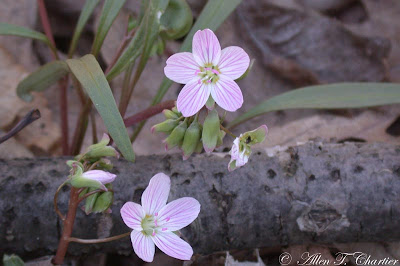
Bloodroot (Sanguinaria canadensis)...


Sharp-lobed Hepatica (Hepatica acutiloba)...

Dutchman's Breeches (Dicentra cucullaria)...

...and Cut-leaved Toothwort (Dentaria laciniata).

A number of less conspicuous flowers were also found. Although the purplish stems of Blue Cohosh (Caulophyllum thalictroides) are fairly conspicous, the flowers can be difficult to see unless you look closely.

Although there were leaves everywhere of the Large-flowered Trillium (Trillium grandiflorum), only a few were in bloom.

And, even fewer Northern Blue Violets (Viola septentrionalis) were in bloom.


A familiar sight in woodlands throughout Michigan this time of year is the Spicebush shrub (Lindera benzoin) with its yellow flowers. Less familiar, because it is somewhat rare, is the Leatherwood shrub (Dirca palustris).

Among the non-flowering species, the Christmas Fern (Polystichum acrostichoides), which stays green all winter, was easily found.


Spring wildflowers were in bloom everywhere, and "getting close to the earth" means laying down on your belly in the trail in order to see them well. Skunk Cabbage (Symplocarpus foetidus) is the earliest blooming wildflower around here, often getting covered over with late snowfalls. The patches of large green leaves indicated that most of this species had bloomed weeks ago, but some of the odd flowers of this plant were still in evidence.


Another species that was forming carpets of green in certain areas was Marsh Marigold (Caltha palustris).


On the drier parts of the forest floor, one of the commonest wildflowers was the Rue Anemone (Anemonella thalictroides).

And many of the conspicuous "usual suspects" that are expected in a Michigan woods this time of year were in bloom, including Spring Beauty (Claytonia virginica)...

Bloodroot (Sanguinaria canadensis)...


Sharp-lobed Hepatica (Hepatica acutiloba)...

Dutchman's Breeches (Dicentra cucullaria)...

...and Cut-leaved Toothwort (Dentaria laciniata).

A number of less conspicuous flowers were also found. Although the purplish stems of Blue Cohosh (Caulophyllum thalictroides) are fairly conspicous, the flowers can be difficult to see unless you look closely.

Although there were leaves everywhere of the Large-flowered Trillium (Trillium grandiflorum), only a few were in bloom.

And, even fewer Northern Blue Violets (Viola septentrionalis) were in bloom.

Even an orchid species was found, though it wasn't in bloom. The striped leaves of the Puttyroot, or Adam and Eve Orchid (Aplectrum hyemale), is very conspicuous in early spring, but will whither before the plant flowers in late May.

A familiar sight in woodlands throughout Michigan this time of year is the Spicebush shrub (Lindera benzoin) with its yellow flowers. Less familiar, because it is somewhat rare, is the Leatherwood shrub (Dirca palustris).

Among the non-flowering species, the Christmas Fern (Polystichum acrostichoides), which stays green all winter, was easily found.

And a couple species of sedge, this one unidentified (I don't do sedges!), were in flower.

Other plants found in the woods today included Spring Cress (Cardamine bulbosa), Field Horsetail (Equisetum arvense), Mayapple (Podophyllum peltatum), Beechdrops (Epifagus virginiana,seed pod only), Wood Strawberry (Fragaria vecsa), and Harbinger-of-spring (Erigenia bulbosa).
Insects were very much in evidence, not the least of which was the cloud of gnats that seemed to be everywhere I wanted to go. No biting insects were out, however. Among the butterflies seen were Mouning Cloak (Nymphalis antiopa), Cabbage White (Pieris rapae), Eastern Comma (Polygonia comma), and Spring Azure (Celastrina ladon). A couple of Green Darners (Anax junius) were the only dragonflies seen.
There was much activity around the blooming flowers, many pollinators getting some of their first feedings of the spring. But few honeybees (Apis mellifera) were out, only a few Carpenter Bees (Xylocopa virginica). The main pollinator seemed to be the Large Bee Flies (Bombylius major). Here is one on a Bloodroot flower.

Brown Click Beetles (Melanotus sp.) were out doing whatever it is they do.

And this tiny jumping spider was hunting the leaf litter. I believe it is Pelegrina proterva.

Reptiles and amphibians emerge in the spring as well, and in addition to a fleeting look at a Common Garter Snake (Thamnophis sirtalis), I managed a photo of this Northern Ribbon Snake (Thamnophis sauritus septentrionalis). A Painted Turtle (Chrysemys picta) was sunning in the river.

Frogs and toads were heard calling, including Western Chorus Frog (Pseudacris triseriata), Eastern Gray Treefrog (Hyla versicolor), and American Toads (Bufo americanus). At the breeding pond where Spotted Salamanders (Ambystoma maculatum) can be found, I had no luck, but at other places in the woods I did see a few Red-backed Salamanders (Plethodon cinereus). Due to the warm temperatures - it was approaching 70 degrees - most of them were much more active than they usually are on cool damp mornings, so I managed but one photo of a single individual of the "lead-backed" color morph.

And of course, there were the birds. Thirty-one species were either seen or heard. One of my favorites of the day was the Louisiana Waterthrush (Seiurus motacilla) whose song rang throughout the woods during most of the morning.

Once I located the singer and took a few photos, for nearly an hour I enjoyed its beautiful song, in this beautiful woods, on this beautiful planet.
Subscribe to:
Posts (Atom)


