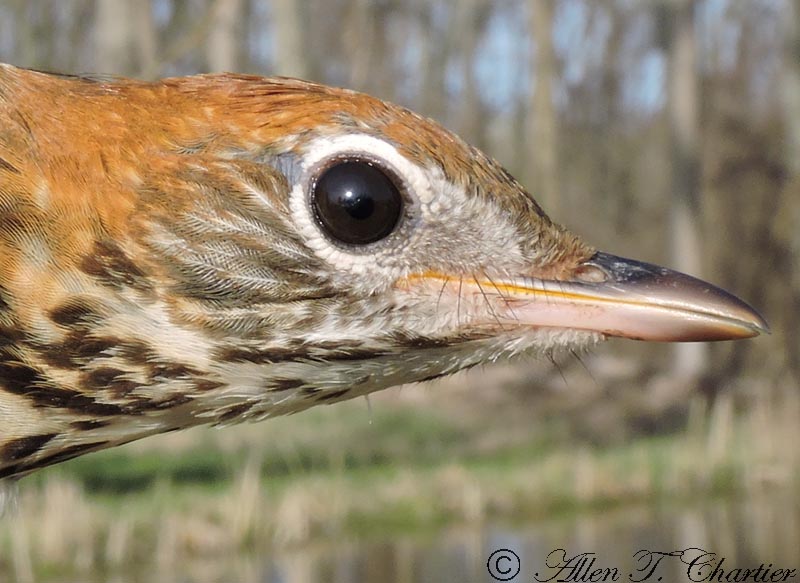
Wednesday, May 25, 2016

Lake St. Clair Metropark Bird Banding Report - May 6-21, 2016

Getting out to band this month has been difficult. Some difficulties included an occasional shortage of volunteers, and inconveniences of my own schedule too. But mostly, it has been Mother Nature who has hindered us, with a wetter than normal spring. We were able to get out on May 6 and 8, but then we had an 11-day gap before banding again on May 19 and 21. Two days in that gap had to be cancelled due to rain, wind, or cold temperatures (on one day, all three!).

On Friday, May 6, the first (3) Warbling Vireos of the season were banded.
After hatch-year Warbling Vireo


And right on schedule, we also has the season's first Veery.
After hatch-year Veery


Although not the first of the season, today's captures of Yellow Warbler signaled a clear influx of birds, mostly males. It is also interesting to notice the total number of Yellow Warblers banded on all four days, which comes close to the record banded back at the Point Rosa Marsh station. Do they nest in higher densities in this habitat? Another Field Sparrow was banded, bringing the season's total to 4, which is double the spring record back in the marsh. The first Baltimore Oriole of the spring was banded in the nets adjacent to the hummingbird feeders, which wasn't surprising.
After hatch-year female Baltimore Oriole


Interesting birds observed, but not banded included a male Eastern Bluebird sitting on top of one of the nest boxes in the Meadow Nets area. But it didn't stay. And an Indigo Bunting was heard briefly as a flyover. As the day warmed up, the American Toads in the Channel started calling, providing good photo (and video) opportunities.
American Toad


On Sunday, May 8, an unusual capture was a Mourning Dove. This species is large enough to often "bounce out" of the nets we use for songbirds as the mesh is not large enough to hold most of them.
After hatch-year female Mourning Dove


The second species of flycatcher to arrive, after Eastern Phoebe, is typically Least Flycatcher, which often arrives in late April. But not this year. Today's Least Flycatcher was the first of the spring here.
After hatch-year Least Flycatcher


In spring, the contrast between the grayish crown and greenish back is usually more obvious than on some birds in the fall.
After hatch-year Least Flycatcher


Two Blue-gray Gnatcatchers in the same net, and close together, was unusual since previously only one or two in any single season was the norm. Perhaps yet another difference this new location will consistently show us?
After hatch-year male Blue-gray Gnatcatcher


It was a good day for warblers, and not just another bunch of Yellows! A bit unusual was an Orange-crowned.
After hatch-year male Orange-crowned Warbler


The orange crown of males is very well hidden at the bases of the crown feathers.
After hatch-year male Orange-crowned Warbler


Other "early" warbler migrants that are expected this time of year includes Nashville, Palm, and Yellow-rumped, all of which were banded today.
After hatch-year male Nashville Warbler


The more extensive chestnut in the crown of males (females have chestnut, but less) is mostly hidden by the broad gray tips of the crown feathers, but is less hidden than the crown patch of Orange-crowned Warbler.
After hatch-year male Nashville Warbler


Sexing (Western) Palm Warblers by the extent of chestnut on the crown is something I'm not entirely comfortable with.
After hatch-year (male?) Palm Warbler


After hatch-year (male?) Palm Warbler


After hatch-year (female?) Palm Warbler


Sexing Yellow-rumped (Myrtle) Warblers is a little easier, as males tend to have more black on the head, and more blue-gray (instead of brownish) on the back, and brighter and more extensive yellow (and longer wings, on average).
After hatch-year male Yellow-rumped Warbler


After hatch-year male Yellow-rumped Warbler


It was also a good day for sparrows, with several handsome White-crowned Sparrows captured.
After hatch-year White-crowned Sparrow


Lincoln's Sparrows are expected to arrive in early May, but the 8 banded today was an unexpectedly large number. This subtly marked sparrow is one of my favorites. It also has a beautiful, almost thrush-like song.
After hatch-year Lincoln's Sparrow


And the 5 Baltimore Orioles banded today was more than expected.
After second-year male Baltimore Oriole


Interesting birds observed, but not banded today included a flyover Green Heron, Black-throated Green Warbler, Ovenbird, Northern Waterthrush, and Orchard Oriole.

Thursday, May 19 saw the first (5) Ruby-throated Hummingbirds of the season banded, although they surely arrived in the area sometime in the 11 days since we were last able to band here (thanks mostly to a wetter than normal spring).
After hatch-year male Ruby-throated Hummingbird


After hatch-year female Ruby-throated Hummingbird


Two more Blue-gray Gnatcatchers were a surprise, and the spring's first Swainson's Thrush was released without a photo. Thrush and flycatcher numbers seem quite low this spring so far. Another good bunch of Yellow Warblers was banded, along with the first American Redstart of the spring, which was a female (males typically arrive first...but perhaps that happened in the 11-day gap when we couldn't band).
After hatch-year female American Redstart


It was also nice to band a couple of brightly-colored male Magnolia Warblers.
After second-year male Magnolia Warbler


After second-year male Magnolia Warbler
A second-year female Black-throated Blue Warbler had a smaller than normal white patch on the wing, which is something we see more often on hatch-year females in fall.
Second-year female Black-throated Blue Warbler


Other warblers banded today included Nashville, Ovenbird, Northern Waterthrush, and Common Yellowthroat. A Field Sparrow was the 5th of the spring. And even more Baltimore Orioles (7) were banded today than last week. Interesting birds observed, but not banded, included a flyover Black-bellied Plover, Tennessee Blackburnian, and Blackpoll (3) Warblers.

On Saturday, May 21, we encountered some very sparse sprinkles in the morning, which turned into a light shower for about 15 minutes, which forced us to close the nets for 30 minutes, and set up a canopy to keep us dry. During the net run to close the nets, the highlight of the day (or the season?) was captured. The volunteers are seen here huddling around it, to take photos. What is it?
Banding volunteers photographing a great bird.


It was the 9th Black-billed Cuckoo ever banded in the park, and only the second since 1997!
After hatch-year Black-billed Cuckoo


Another Ruby-throated Hummingbird banded was a highlight, as always. There was less warbler diversity today, but this adult male American Redstart was a nice catch.
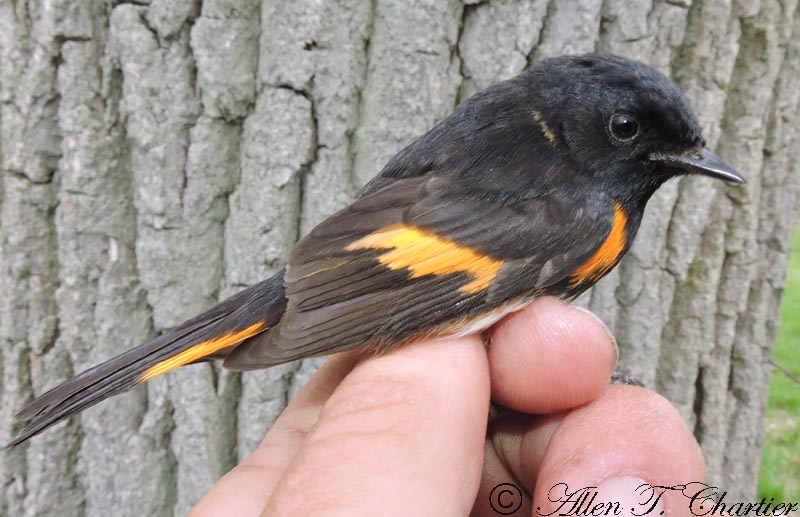
After second-year male American Redsart


And the first Chestnut-sided Warbler banded here this spring was a female, signalling that their migration is past peak.
Second-year female Chestnut-sided Warbler


Females have less brilliant yellow crowns, less black in the face, and less chestnut on the flanks.
Second-year female Chestnut-sided Warbler


Other warblers banded today included a few more Yellows, Magnolia, and Black-throated Blue, but the warbler of the day was Common Yellowthroat, with a surprising 11 banded today...there is not a lot of marsh or wetland in the banding area.
After second-year male Common Yellowthroat


Surely, the brightest bird banded today was the male Indigo Bunting.
After second-year male Indigo Bunting


After second-year male Indigo Bunting


Interesting birds observed but not banded today included this Great Egret that attempted (and failed) to swallow a large perch that it had stabbed in the channel right behind the banding table.
Great Egret


Banding on these four days could not have been done without the help of very eager and capable volunteers, including John Bieganowski, Jacob Charlebois, Caitlyn Hogan, Stevie Kuroda, Dave Lancaster, Harry Lau, Rose Lau, Ava Lau, Tessa Lau, Joan Tisdale, Bruce Watson, and Blanche Wicke.

Bird Banding Results

May 6, 2016

Time open (E.S.T.): 6:00
Time closed (E.S.T.): 13:45
Hours Open:6.75
Net Hours: 110.375
Temperature (F): 46-70
Cloud Cover: 40-60-10%
Wind Direction: NNW-NE
Wind Speed (mph): 7-10
Barometer: 29.28 - 29.24
Precipitation: None
No. Banded: 79 (plus 8 recaptured and 1 released unbanded)
Species Captured: 22
Capture Rate (#/100 net hours): 79.7
Banding Assistants (9.5 hours worked): John Bieganowski, Dave Lancaster, Joan Tisdale (4 hrs).

Warbling Vireo - 3
Blue Jay - 2
Tree Swallow - 1
Black-capped Chickadee - 1 (plus 1 recaptured)
Tufted Titmouse - 1
House Wren - 1
Veery - 1
Hermit Thrush - 4
American Robin - 4 (plus 1 recaptured)
Yellow Warbler - 15 (plus 2 recaptured)
Common Yellowthroat - 1
Field Sparrow - 1
Song Sparrow - 3 (plus 3 recaptured)
Swamp Sparrow - 3
White-throated Sparrow - 3
Northern Cardinal - 1
Red-winged Blackbird - 15 (plus 1 recaptured, 1 released unbanded)
Common Grackle - 3
Baltimore Oriole - 1
American Goldfinch - 3
House Sparrow - 1
-----------------------------------------------

May 8, 2016

Time open (E.S.T.): 5:45
Time closed (E.S.T.): 12:00
Hours Open: 6.25
Net Hours: 101.625
Temperature (F): 45-63
Cloud Cover: 10-50%
Wind Direction: WNW-SE
Wind Speed (mph): 5-7-10
Barometer: 29.23 - 29.29
Precipitation: None
No. Banded: 121 (plus 15 recaptured and 5 released unbanded)
Species Captured: 29
Capture Rate (#/100 net hours): 138.7
Banding Assistants (8.0 hours worked): Jacob Charlebois, Caitlyn Hogan, Stevie Kuroda, Bruce Watson.

Mourning Dove - 1
Northern Flicker - 1
Least Flycatcher - 1
Black-capped Chickadee - 1
White-breasted Nuthatch - 1
Ruby-crowned Kinglet - 7
Blue-gray Gnatcatcher - 2
Hermit Thrush - 2
Wood Thrush - 1
American Robin - 4
Gray Catbird - 1 (2 recaptured)
European Starling - 1
Orange-crowned Warbler - 1
Nashville Warbler - 4
Yellow Warbler - 18 (plus 7 recaptured, 1 released unbanded)
Yellow-rumped Warbler - 5
Palm Warbler - 5
Common Yellowthroat - 4 (plus 1 recaptured)
Song Sparrow - 2 (plus 3 recaptured, 1 released unbanded)
Swamp Sparrow - 6
Lincoln's Sparrow - 8
White-throated Sparrow - 13
White-crowned Sparrow - 4
Northern Cardinal - 3
Red-winged Blackbird - 13 (plus 1 recaptured, 3 released unbanded)
Common Grackle - 3
Brown-headed Cowbird - 3
Baltimore Oriole - 5 (plus 1 recaptured)
American Goldfinch - 1
-----------------------------------------------

May 19, 2016

Time open (E.S.T.): 5:30
Time closed (E.S.T.): 12:15
Hours Open: 6.75
Net Hours: 110.375
Temperature (F): 45-68
Cloud Cover: 10-0%
Wind Direction: Calm-SE
Wind Speed (mph): 0-3
Barometer: 29.56 - 29.57
Precipitation: None
No. Banded: 69 (plus 23 recaptured)
Species Captured: 25
Capture Rate (#/100 net hours): 83.4
Banding Assistants (8.5 hours worked): John Bieganowski, Dave Lancaster, Harry Lau, Rose Lau, Ava Lau, Tessa Lau, Blanche Wicke (7.0 hrs).

Ruby-throated Hummingbird - 5
Warbling Vireo - 1
Tree Swallow - 1 (plus 1 recaptured)
Blue-gray Gnatcatcher - 2
Swainson's Thrush - 1
American Robin - 5
Gray Catbird - 4 (plus 1 recaptured)
Nashville Warbler - 1
Yellow Warbler - 16 (plus 9 recaptured)
Magnolia Warbler - 2
Black-throated Blue Warbler - 1
American Redstart - 2
Ovenbird - 1
Northern Waterthrush - 1
Common Yellowthroat - 5
Field Sparrow - 1
Song Sparrow - 1 (plus 2 recaptured)
Swamp Sparrow - 2
White-crowned Sparrow - 1
Northern Cardinal - 2
Red-winged Blackbird - 5 (plus 3 recaptured)
Common Grackle - 1
[Brown-headed Cowbird - 1 recaptured]
Baltimore Oriole - 7 (plus 1 recaptured)
American Goldfinch - 2 (plus 3 recaptured)
-----------------------------------------------

May 21, 2016

Time open (E.S.T.): 5:30
Time closed (E.S.T.): 12:30
Hours Open: 6.5 (closed 9:00 - 9:30 due to rain)
Net Hours: 106.00
Temperature (F): 57-64
Cloud Cover: 100%
Wind Direction: NNW-NE
Wind Speed (mph): 1-3-7
Barometer: 29.38 - 29.42
Precipitation: Trace Rain
No. Banded: 44 (plus 25 recaptured)
Species Captured: 19
Capture Rate (#/100 net hours): 65.1
Banding Assistants (8.5 hours worked): Jacob Charlebois (7.5 hrs), Caitlyn Hogan (7.5 hrs), Stevie Kuroda (8.0 hrs), Bruce Watson (8.0 hrs), Blanche Wicke.

Ruby-throated Hummingbird - 1
Downy Woodpecker - 1
Warbling Vireo - 1
[Black-capped Chickadee - 2 recaptured]
House Wren - 1
American Robin - 1 (plus 1 recaptured)
Black-billed Cuckoo - 1
Yellow Warbler - 3 (plus 10 recaptured)
Chestnut-sided Warbler - 1
Magnolia Warbler - 3
Black-throated Blue Warbler - 1
American Redstart - 4 (plus 1 recaptured)
Common Yellowthroat - 11
Song Sparrow - 1 (plus 3 recaptured)
[Northern Cardinal - 1 recaptured]
Indigo Bunting - 1
Red-winged Blackbird - 10 (plus 1 recaptured)
Baltimore Oriole - 2 (plus 6 recaptured)
American Goldfinch - 1
-----------------------------------------------

Monday, May 2, 2016

Lake St. Clair Metropark Bird Banding Report - April 27 & 30, 2016

For the first time this spring, we were able to band twice in one week as our schedule dodged the rainy days in the forecast. There were some expected spring arrivals, but in general there was a bit of a lull in migration.

On Wednesday, April 27, a few new arrivals were noted, including the first House Wren of the season.
After hatch-year House Wren


Three species of warbler found their way into our nets. A Northern Waterthrush was heard singing near the Channel Nets when we were opening, and on the first net run it was still singing in the nearby dogwoods, but there was also another one in the nets!
After hatch-year Northern Waterthrush


In spring, some Northern Waterthrushes are not as yellow as some birders might expect, as with this individual. They are typically more yellow in their fresher fall (and first basic) plumage. So, identification should be based on the spotting on the throat, and narrower supercilium behind the eye of Northern.
After hatch-year Northern Waterthrush


A little surprising, since we did not hear any singing, was a male Common Yellowthroat in the same net as the Waterthrush.
After hatch-year male Common Yellowthroat


After hatch-year male Common Yellowthroat


A couple of Yellow Warblers were heard singing in the banding area, and so it was not surprising that we caught one today. But what was surprising is that it was a female, which usually arrive after the males.
After second-year female Yellow Warbler


The highlight of the day was the male Eastern Towhee, which was also captured in the Channel Nets (great spot today!).
After hatch-year male Eastern Towhee


Interesting birds observed but not banded included two flyover Common Loons, a Sharp-shinned Hawk, Chimney Swift, Purple Martin, two Blue-gray Gnatcatchers, and two singing Brown Thrashers. In a class by itself was the male Eastern Bluebird in the trees next to the Nature Center. Unlike almost any other Metropark, this species is very rare at Lake St. Clair Metropark and was only the second time volunteer John Bieganowski and I have ever seen it in the park, and we've each been birding here for about 40 years.

On Saturday, April 30, there were fewer birds around, and fewer captured. One highlight was a singing Wood Thrush during setup that was captured on the first net run, which was a first for the spring.
After hatch-year Wood Thrush


After hatch-year Wood Thrush


The first Gray Catbird (no photo) of the spring was captured today.  Another Yellow Warbler was banded, this one a male, but another male Yellow Warbler was more interesting as it had been banded back at the Point Rosa Marsh station in spring 2014 (0.4 miles away) as a second-year bird.
4th year male Yellow Warbler


Other interesting recaptures today included a male Downy Woodpecker banded as a hatch-year at the Point Rosa Marsh station in fall 2012, making him a 5th year bird (actual age 3 yrs 10 mos). And two American Goldfinches, a male and female within inches of each other in the Meadow Nets, were both banded back at the marsh; the male in fall 2010 as a hatch-year making him a 7th year (actual age 5 yrs 10 mos), and the female in fall 2011 as an after hatch-year making her an after 6th year (actual age at least 5 yrs 10 mos).

Interesting birds observed but not banded included a flyover Lesser Yellowlegs (no shorebird habitat in the banding area), three Rock Pigeons (they roost less than a mile outside the park entrance, but are rarely observed in the park), and a flyover Sandhill Crane.

Banding could not have been conducted on these two days without the very welcome help of volunteers, including: John Bieganowski, Jacob Charlebois, Caitlyn Hogan, Marie McGee, Ann ross, and Blanche Wicke.

Bird Banding Results

April 27, 2016

Time open (E.S.T.): 6:00
Time closed (E.S.T.): 13:00
Hours Open: 7.0
Net Hours: 113.25
Temperature (F): 36-57
Cloud Cover: 10-20%
Wind Direction: NNW-NE
Wind Speed (mph): 3-5-10
Barometer: 30.06 - 30.02
Precipitation: None
No. Banded: 42 (plus 11 recaptured and 2 released unbanded)
Species Captured: 17
Capture Rate (#/100 net hours): 48.6
Banding Assistants (10.0 hours worked): John Bieganowski, Marie McGee.

{Northern Flicker - 1 released unbanded}
Tree Swallow - 1
[Black-capped Chickadee - 1 recaptured)
House Wren - 1
Ruby-crowned Kinglet - 7
Hermit Thrush - 1
American Robin - 2 (plus 1 recaptured)
Yellow Warbler - 1
Northern Waterthrush - 1
Common Yellowthroat - 1
Eastern Towhee - 1
Field Sparrow - 1
[Song Sparrow - 3 recaptured]
Swamp Sparrow - 6 (plus 1 recaptured)
White-throated Sparrow - 5
Northern Cardinal - 1 (plus 4 recaptured)
Red-winged Blackbird - 10 (plus 1 recaptured)
Common Grackle - 3
{American Goldfinch - 1 released unbanded}
-----------------------------------------------

April 30, 2016

Time open (E.S.T.): 5:45
Time closed (E.S.T.): 12:30
Hours Open: 6.75
Net Hours: 110.375
Temperature (F): 41-59
Cloud Cover: 5-100%
Wind Direction: NE-E
Wind Speed (mph): 1-3-5
Barometer: 29.52 - 29.50
Precipitation: None
No. Banded: 31 (plus 11 recaptured and 3 released unbanded)
Species Captured: 20
Capture Rate (#/100 net hours): 40.8
Banding Assistants (9.0 hours worked): Jacob Charlebois, Caitlyn Hogan, Ann Ross, Blanche Wicke.

[Downy Woodpecker - 1 recaptured]
Blue Jay - 1
Tree Swallow - 1
{House Wren - 1 released unbanded}
Ruby-crowned Kinglet - 2 (plus 1 recaptured)
Hermit Thrush - 2 (plus 1 released unbanded)
Wood Thrush - 1
American Robin - 1
Gray Catbird - 1
European Starling - 1
Yellow Warbler - 1 (plus 1 recaptured)
[Northern Waterthrush - 1 recaptured]
Song Sparrow - 1 (plus 1 recaptured)
Swamp Sparrow - 1 (plus 1 recaptured, 1 released unbanded)
[White-throated Sparrow - 1 recaptured]
Northern Cardinal - 1 (plus 1 recaptured)
Red-winged Blackbird - 9
Common Grackle - 3
Brown-headed Cowbird - 3 (plus 1 recaptured)
American Goldfinch - 1 (plus 2 recaptured)
House Sparrow - 1
-----------------------------------------------

Monday, April 25, 2016

Lake St. Clair Metropark Bird Banding Report - April 23, 2016

This week, once again, I was able to band on only one day. This time, though, it was my fault as I did have volunteers for another day but my personal schedule changed at the last minute and conflicted with banding. Next week looks good for banding on two days!

Saturday, April 23, started out chilly at 37 degrees, and warmed up to 54. But the moderate north wind and cloudless sky may have reduced our catch because the nets were quite visible. The slow pace of leaf-out (non-existent so far), also made the nets visible to birds.

A second-year female Northern Flicker was a nice capture, and the second one so far this spring.
Second-year female Northern Flicker


Ageing woodpeckers is a bit tricky, and I will not claim to be an expert on this, but I am starting to get the hang of it thanks to a "key" that was distributed to banders a few years ago. Unfortunately, I don't remember who sent it out, but it has been very helpful. Woodpeckers are aged based on molt patterns, including primary coverts, primaries, and secondaries. There is variation in this pattern, which makes it more challenging. For example, the two Yellow-bellied Sapsuckers banded on April 3 had two different patterns on their primary coverts, but were both aged as after second-year. The brown plumage of flickers is also more challenging than the black plumage of most other woodpeckers. It appeared to me that this female had two different ages of primary coverts, with the outer two new and fresh, with the remaining ones worn and duller. In spring, flickers with a "molt limit" in the primary coverts, and only two ages (they can have up to three), indicates a second-year bird.
Second-year female Northern Flicker


Many of the flickers we catch seem to have soil encrusted on their bills, an indication of their partially terrestrial feeding habits.
Second-year female Northern Flicker


At the Point Rosa Marsh station, we banded a total of 14 Blue-gray Gnatcatchers over 10 years (10 in spring),with the earliest on 25 April, so it was nice to catch one today, beating that date by two days. As males of many species typically arrive first, it was interesting that this was a female.
After hatch-year female Blue-gray Gnatcatcher


It can be sexed as female, in the spring, by the lack of black eyebrow.
After hatch-year female Blue-gray Gnatcatcher


The kinglet captures today were all Ruby-crowned, and mostly males. So we are seeing a transition from Golden-crowned, which have mostly departed to the north, to the later-migrating Ruby-crowned. 

One expectation I had for this new banding site in the park was that because it was not marsh and swamp like the previous site, we would not catch very many Swamp Sparrows. So far, that expectation has been altered by the capture of several each day so far.
After hatch-year Swamp Sparrow


One assumption that some birders make is that the individuals with more extensive rufous in the crown are males, or older birds. But as banders, we do not have ANY plumage criteria that allow us to assign a sex to them, and ageing is done by the extent of skull ossification in the fall, and subtle molt criteria (in the primary coverts) in the spring. It is true that juveniles in late summer will never have rufous in the crown, but beyond that, birders should chalk the differences observed in crown color up to individual variation. The Swamp Sparrow shown below was also captured today, with obviously much less rufous.
After hatch-year Swamp Sparrow


When starting this new banding station, I wrestled with whether or not I'd band any European Starlings or House Sparrows. Some stations release these non-native (invasive) species unbanded. At the Point Rosa Marsh station, I was banding them because my predecessor (Ellie Cox) had banded them. I decided that I would band everything captured at this station, though if in the fall I end up catching too many I will likely release some if I get too busy. Today we banded one of each, including the male House Sparrow below.
After hatch-year male House Sparrow


This bird shows its black bib in transition from smaller in winter to larger in summer. Unlike many species, this is not because of molt, but due to feather wear. The broad pale gray tips on the throat feathers that are molted in the fall gradually wear off until in spring only the black bases remain.

Probably THE highlight of the day came in the form of a recaptured female American Goldfinch. Not only was it banded at the Point Rosa Marsh station, 0.4 miles away, but she was banded in 2010 as a second-year female. That makes her 6 years 10 months old!
7th year female American Goldfinch


Interesting birds observed, but not banded, included three flyover Common Loons,  two flyover Sandhill Cranes, a Yellow-bellied Sapsucker in a tree next to the banding table, and a singing Pine Warbler in the pines near the bike path.

It was nice having a couple of friends drop by and watch for a while; Janet Hug and Don Burlett.

Thanks to the many volunteers who helped out today, including: Andrea Charlebois, Jacob Charlebois, Caitlyn Hogan, Stevie Kuroda, Katie-Ann McKlinsky, Edie Schmitz, Joan Tisdale, and Blanche Wicke.

Bird Banding Results

April 23, 2016

Time open (E.S.T.): 5:30
Time closed (E.S.T.): 12:45
Hours Open: 7.25
Net Hours: 119.125
Temperature (F): 37-54
Cloud Cover: 0-10%
Wind Direction: N
Wind Speed (mph): 7-10
Barometer: 30.18 - 30.24
Precipitation: None
No. Banded: 50 (plus 13 recaptured)
Species Captured: 17
Capture Rate (#/100 net hours): 52.9
Banding Assistants (9.0 hours worked): Andrea Charlebois (2.0 hrs), Jacob Charlebois (5.5 hrs), Caitlyn Hogan (5.5 hrs), Stevie Kuroda, Kaitie-Ann McKlinsky, Edie Schmitz, Joan Tisdale, Blanche Wicke.

[Downy Woodpecker - 1 recaptured]
Northern Flicker - 1
Tree Swallow - 2
Black-capped Chickadee - 1 (plus 5 recaptured)
Ruby-crowned Kinglet - 14
Blue-gray Gnatcatcher - 1
Hermit Thrush - 1
American Robin - 1
European Starling - 1
Song Sparrow - 1 (plus 3 recaptured)
Swamp Sparrow - 7
White-throated Sparrow - 3
Northern Cardinal - 4 (plus 2 recaptured)
Red-winged Blackbird - 6 (plus 1 recaptured)
Common Grackle - 3
American Goldfinch - 3 (plus 1 recaptured)
House Sparrow - 1
-----------------------------------------------

Thursday, April 21, 2016

Lake St. Clair Metropark Bird Banding Report - 16 April 2016

My intended protocol for banding twice each week is really taking a beating so far. As reported for April 3, winter made an unwelcome return, and from that date until about April 12, conditions were clearly unsuitable for spring banding, with snow and freezing temperatures on many days. So, after a lapse of 13 days, we were all happy to return to the park to band birds. And we weren't disappointed. There were LOTS of birds around, including a few birds that head north early in the spring, and others in numbers greater than we ever had back in the Pt. Rosa Marsh banding area.

Eastern Phoebes are, by far, the earliest migrant flycatcher through the park, so it was expected that they would be around today, and we managed to catch one of them.
Second-year Eastern Phoebe


Tree Swallows have been back for a while, but the last time we banded it was so chilly that they were not hanging around the nest boxes in the banding area, but instead were hawking for insects low over the water in the marshes. Today, they were back at the boxes and we caught one that was not banded. I'm hoping to catch one (of 18) that I banded last summer as a nestling.
After hatch-year male Tree Swallow


The close-up below shows the black forward-facing feathers in front of the eyes that is thought to act as an anti-glare mechanism to help them see better when catching insects in flight.
After hatch-year male Tree Swallow


Winter Wrens were also in evidence today, and the 4 captured was one greater in a single spring day than at the Point Rosa site.
After hatch-year Winter Wren


After hatch-year Winter Wren


Both Golden-crowned and Ruby-crowned Kinglets migrate in mid-April, with Golden-crowned moving through earlier. The 32 Golden-crowned Kinglets banded today was an indication that we were still in the early part of kinglet migration, although the preponderance of females suggests that we're in the latter part of their movements. They will be entirely gone before the end of April here. And it was far more than I've ever banded in a single spring day in Point Rosa Marsh (but not more than in fall). Ruby-crowned Kinglets are expected to start migrating in mid-April, but the 5 banded today was a bit more than expected for this early, and all were males as anticipated.
After hatch-year male Ruby-crowned Kinglet


Hermit Thrushes have been trickling into the state for the past couple of weeks, but the 18 banded today was clearly an influx, and more than on any spring (but not fall) day in Point Rosa Marsh.
Second-year Hermit Thrush


It was also a good sparrow day, which should be the case throughout the month of April. Not the first banded of the spring, this White-throated Sparrow was so bright that I wanted to include a photo, and its plumage was fresh so it may have been a migrant rather than an overwintering bird. I sometimes see birders refer to "female" or "immature" White-throated Sparrows based on their brightness or dullness, but this is extremely variable, to the point that as banders we cannot age or sex them based on any plumage characters.
After hatch-year White-throated Sparrow


After hatch-year White-throated Sparrow


Early migrating sparrows were also well represented, with 2 American Tree Sparrows, and the first (and possibly last) Dark-eyed Junco of the spring.
After hatch-year female Dark-eyed Junco


It was an excellent day for Fox Sparrows, with the 6 banded equaling the highest for a single day in spring at the Point Rosa Marsh banding site.
After hatch-year Fox Sparrow


Two Field Sparrows were a surprise, as they have not yet peaked in migration, and was more than any spring day previously.
After hatch-year Field Sparrow


The lack of Common Grackles captured so far seems a little surprising. Perhaps they prefer to forage in the swamp woods instead of a meadow in the spring. Only one was captured today.
After second-year female Common Grackle


Interesting recaptures included two Northern Cardinals banded at the station in Point Rosa Marsh (0.4 miles away), one in 2014 and one in 2012. 

Thanks very much to Annie Crary, Stevie Kuroda, Joan Tisdale, Bruce Watson, and Blanche Wicke for helping out today. It is always great to have such capable volunteers on very busy days.

Bird Banding Results

April 16, 2016

Time open (E.S.T.): 5:30
Time closed (E.S.T.): 12:30
Hours Open:7.0
Net Hours:114.00
Temperature (F):41-66
Cloud Cover: 20-10%
Wind Direction:Calm-N-E
Wind Speed (mph):0-5
Barometer: 30.38 - 30.44
Precipitation: None
No. Banded: 127 (plus 16 recaptured and 2 released unbanded)
Species Captured:25
Capture Rate (#/100 net hours): 127.2
Banding Assistants (8.5 hours worked): Annie Crary, Stevie Kuroda (8.0 hrs), Joan Tisdale, Bruce Watson (8.0 hrs), Blanche Wicke.

[Downy Woodpecker - 1 recaptured]
Northern Flicker - 1
Eastern Phoebe - 1
Blue Jay - 1
Tree Swallow - 1
Black-capped Chickadee - 1 (plus 2 recaptured)
[Tufted Titmouse - 1 recaptured]
Brown Creeper - 1
Winter Wren - 4
Golden-crowned Kinglet - 32
Ruby-crowned Kinglet - 5
Hermit Thrush - 18
American Robin - 7 (plus 3 recaptured)
American Tree Sparrow - 2
Field Sparrow - 2
Fox Sparrow - 6
Song Sparrow - 13 (plus 3 recaptures)
Swamp Sparrow - 8
White-throated Sparrow - 1
Dark-eyed Junco - 1
Northern Cardinal - 3 (plus 6 recaptured, 1 released unbanded)
Red-winged Blackbird - 13 (plus 1 released unbanded)
Common Grackle - 2
Brown-headed Cowbird - 2
American Goldfinch - 2
-----------------------------------------------

Saturday, April 9, 2016

A New Beginning - Bird Banding at Lake St. Clair Metropark

Bird banding has been conducted at Lake St. Clair Metropark (formerly named Metro Beach Metropark) since 1989. Up until 2014, the banding location was in and near Point Rosa Marsh. Marsh restoration efforts rendered the banding area too difficult to work in, so banding was discontinued there after the fall 2014 season.  Reports are in preparation comparing the 10 years of banding conducted by Ellie Cox there (1989-1999) and my own efforts over 10 years from 2004-2014, and I summarized the 2004-2014 data in my blog post here

During November of 2014, one day in May 2015, and several days in fall of 2015, a new banding area was explored, with good results. New net lanes were established, with the plan to move forward with banding in a new area, and new habitat, adjacent to the Meadow Loop of the Nature Trail. This new site is located 0.4 miles northeast of the Point Rosa Marsh station, and the net locations are shown below.


 In this new area, a total of 15 nets (four 18-meter nets and eleven 12-meter nets, which is 17.5 "standard" nets) will be used in an area that can be encompassed by a circle with an area of 3 acres. The Point Rosa site had a total of 14 nets (15 standard nets). There are six net groups of nets that are color-coded on the map above, and will be tracked for the birds captured in them. White shows what we're calling the Pine Nets, an "L" configuration and a single net. They cut across a row of pines that were planted here in the 1990s and have now grown to more than 20 feet tall. In green are the Meadow Nets, which are on the edge of the pines in an area of open field, where several Tree Swallow nest boxes have been maintained for many years. The single net shown in red is in a dogwood and sumac thicket adjacent to the pines, and is called the Thicket Net. In yellow are four nets in an open area surrounded mostly by dogwood and some cottonwoods which we're calling the Dogwood Nets. This was a very good area for American Woodcocks during 2015, and there were some in the area this spring too. In blue are nets adjacent to a channel that runs east-to-west, and are called the Channel Nets. And finally, the single net in black is called the Bat Net, because it is adjacent to the bat hibernation box that has been in the center of the Meadow Loop for many years.

On April 3, a hardy team of volunteers and I banded at this new station for the first time in 2016, a new beginning to banding in the park. Hopefully the habitat will be managed in a way that there is some consistency for years to come, and will not affect our efforts. It was a very cold morning, starting off at about 25 degrees. So, partly to wait until the temperatures rose a bit, and partly because we were locked out of the park until 7 a.m., we did not get nets open until well after sunrise. So, the hoped-for capture of American Woodcock did not happen, but other species that area around only in early April were captured, including American Tree Sparrow and Golden-crowned Kinglet.
After hatch-year American Tree Sparrow


After hatch-year female Golden-crowned Kinglet


White-throated Sparrows were also captured, which might be overwintering individuals since the peak of migration here is still about three weeks away.
After hatch-year White-throated Sparrow


Two other species that were captured, not highlights, were only rarely captured back in the Point Rosa Marsh, but being so close to the feeders at the Nature Center, I suspect we'll be capturing more European Starlings and House Sparrows in the future.
After hatch-year female European Starling


A few individuals that were already banded, back in 2015 or November 2014, were recaptured today including the first bird of the day, a Song Sparrow, and a Black-capped Chickadee.
After hatch-year Song Sparrow


After hatch-year Black-capped Chickadee


But the clear highlight of the day, and quite a surprise, was TWO adult male Yellow-bellied Sapsuckers. Over the 10 years in Point Rosa Marsh, only 4 were banded and all of those were hatch-year birds, in brown plumage. Both sapsuckers today were in very fine plumage.
After second-year male Yellow-bellied Sapsucker


After second-year male Yellow-bellied Sapsucker


Bird Banding Results

April 3, 2016

Time open (E.S.T.): 8:00 (cold delayed opening)
Time closed (E.S.T.): 12:30 (snow forced early close)
Hours Open: 4.5
Net Hours: 78.75
Temperature (F): 27-32
Cloud Cover: 20-100%
Wind Direction: WSW
Wind Speed (mph): 7-10
Barometer: 30.03 (steady all day)
Precipitation: Intermittent Light Snow
No. Banded: 27 (plus 6 recaptured)
Species Captured: 11
Capture Rate: 41.9/100 net hours
Banding Assistants (8.5 hours worked): Jacob Charlebois (2 hrs), Stevie Kuroda, Joan Tisdale, Bruce Watson, Christian Sammit, Julian Zammit.

Yellow-bellied Sapsucker - 2
Black-capped Chickadee - 1 (plus 1 recaptured)
Brown Creeper - 1
Golden-crowned Kinglet - 9
American Robin - 5 (plus 1 recaptured)
European Starling - 1
American Tree Sparrow - 3
Song Sparrow - 2 (plus 3 recaptured)
White-throated Sparrow - 2
[Northern Cardinal - 1 recaptured]
House Sparrow - 1
--------------------------------------------------