Friday, June 24, 2022

Southwestern Newfoundland

This morning, we left the motel early and drove two hours south almost to Channel-Port Aux Basques, to a road where a lot of warblers had been reported the previous week, including several we had not seen yet. The road was to Red Rocks, and we drove in maybe 2 kilometers before the road became too difficult for our rental SUV. It was clear that there was a lot of good habitat farther up the road, and I walked around a bit but was not able to find as many warblers as had been reported. There are not very many "easy" roads in Newfoundland! There were a couple of nice Bald Eagles sitting on the headlands here, and one flew by fairly close.

Bald Eagle with prey at Red Rocks


On the way back out, I took a photo of an American Robin because there is an endemic subspecies in Newfoundland, Labrador, and northeastern Quebec that is blacker on the head which extends onto the back of males. We were also noticing that their songs seemed a bit different from ours in Michigan.

American Robin (Turdus migratorius nigrideus)


Almost all the way back to the highway, a song stopped us in our tracks. It was the second one we'd heard on the trip, but this one was CLOSE. It was a Northern Parula, which is somewhat of a rarity in Newfoundland. The previous one never showed, but this one was a bit of a showoff; all these photos were taken just by rolling down the car window and aiming the camera. He seemed to be feeding on nectar, or looking for small insects, in the flowers of a small tree that I could only identify to genus (Prunus sp.).

Northern Parula at Red Rocks, Newfoundland


Northern Parula at Red Rocks, Newfoundland


Northern Parula at Red Rocks, Newfoundland


Northern Parula at Red Rocks, Newfoundland


Northern Parula at Red Rocks, Newfoundland


Northern Parula at Red Rocks, Newfoundland


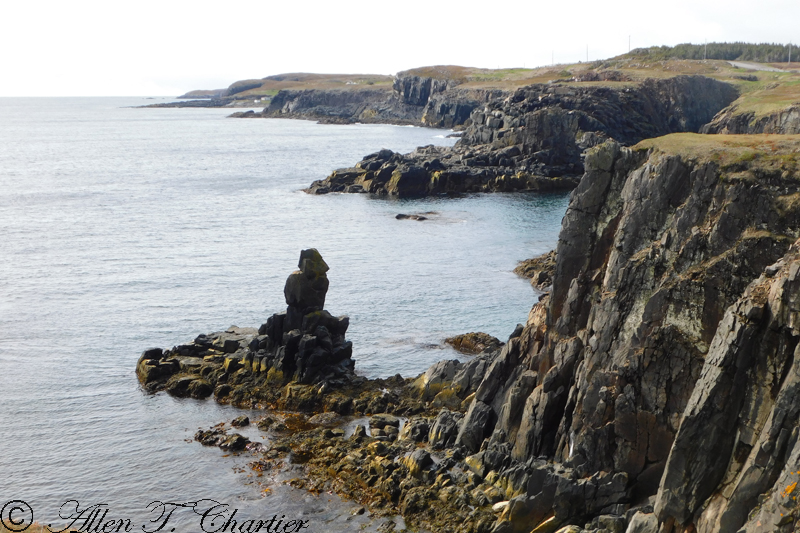
A brief stop at the nearby Cape Ray did not produce the hoped-for close views of Great Cormorants, so we headed back north through the scenic Codroy Valley.

Codroy Valley, Newfoundland


Codroy Valley, Newfoundland


Our next stops were in the Stephensville area, about half way back to Corner Brook. Here we were looking for some rare breeding species on sand bars and mudflats, including Piping Plover, Willet, and Black-headed Gull. We succeeded with all of these, although all of them were rather distant. Our search for Rusty Blackbird, which is a rare breeder here (but more common in Newfoundland than Red-winged Blackbird!), came up empty. So, we headed to another good warbler road, the Brooms Brook Road. But when we got there, we found that there were two really huge wash-outs blocking access to the better parts of the road farther on. It might have been a mile or two to get to habitat where Cape May and Blackburnian Warblers might be found, as what we could see from across the chasm in front of us was deciduous scrub. And since it was noon, we decided that the birds would probably not be singing and it would be a hot hike. A last stop before returning to Corner Brook was Barachois Pond Provincial Park, which was mostly a campground, but it had a short trail and literature about it said there were "rare orchids" that could be found. It was yet another scenic place.

Barachois Pond Provincial Park, Newfoundland


And there were some orchids, although they were Pink Ladyslippers which are quite widespread, and arguably not "rare" even in Newfoundland. Still it was nice to see them.

Pink Ladyslipper (Cypripedium acaule)


Pink Ladyslipper (Cypripedium acaule)


Along the short trail, along with a fresh crop of Black Flies and mosquitoes, another boreal flower was blooming in abundance, the Northern Starflower.

Northern Starflower (Lysimachia borealis)


Birds along this trail included common species like the widespread breeding White-throated Sparrow.

White-throated Sparrow


And one of the rarities we were looking for on the two "warbler" roads earlier in the day popped up for a few backlit photos, a Bay-breasted Warbler.

Bay-breasted Warbler


Bay-breasted Warbler


From here we drove back north for about an hour to Corner Brook for another night.

Thursday, June 23, 2022

City Parks and Mountain Tops, Gander to Corner Brook, Newfoundland

Today was mostly a travel day, with a few specific stops planned. We left Gander early this morning, with our first destination a dirt road going south of the Trans-Canada Highway just west of the town of Appleton. A Black-backed Woodpecker had been reported recently about 6 kilometers down this road. The first 3 kilometers were mostly aspen woodlands, but after that it changed to mostly spruce with some mixed deciduous aspen and alder. This photo is fairly typical of a lot of the boreal forest that covers much of the central part of the island of Newfoundland.

We found a lot of birds, mostly warblers, including this Northern Waterthrush, a species that is possibly one of the most common breeding warblers in Newfoundland, but they are not particularly cooperative for photos.

Northern Waterthrush


We went in 12 kilometers and did not locate any Black-backed Woodpeckers, but had a good birding morning. Separate eBird checklists were kept for 3 kilometer segments of the road, as well as a stop right near the exit off the Trans-Canada Highway, and links to those checklists are provided here for those who might be interested in the details.

https://ebird.org/checklist/S112820055

https://ebird.org/checklist/S112820344

https://ebird.org/checklist/S112821035

https://ebird.org/checklist/S112821487

https://ebird.org/checklist/S112821807

 We had several Canadian Tiger Swallowtails along this road, some of which posed nicely for photos.

Canadian Tiger Swallowtail

From there, we continued west to the city of Grand Falls-Windsor, where we stopped at some sewage treatment ponds where we found a distant Wood Duck, somewhat of a rarity in Newfoundland, along with the usual Mallards, American Black Ducks, and Ring-necked Ducks. At the north end of town, we went to a city park with several trails and ponds, the Corduroy Brook Trails.


Here we saw the typical common breeding warblers, including this cooperative Wilson's Warbler.

Wilson's Warbler


The vegetation was mixed coniferous and deciduous, and the Rhodora (locally called Wild Honeysuckle) blooming was increasing by the day, with many of these low shrubs in full bloom today.

Rhodora (Rhododendron canadense)


Another species that is more widespread in northern woods, including in Michigan, was Bunchberry, a small member of the dogwood family.

Bunchberry (Cornus canadensis)


Our first dragonfly of the trip was seen here also, a Four-spotted Skimmer which is a fairly common species of the north woods from Alaska to Newfoundland, and including northern (and parts of southern) Michigan.

Four-spotted Skimmer (Libellula quadrimaculata)


Continuing west, I had identified a spot that was regularly reporting Rock Ptarmigans. Most birders to Newfoundland do not see this species at all, and the main way to see one is to walk the 12-mile round-trip trail to the top of Gros Morne Mountain in that National Park. This site was marked in eBird as "restricted access". After contacting eBird reviewers in Newfoundland, I was told that it was a road that required a high clearance vehicle, and possibly all-wheel drive, but access was not restricted for any other reason. It was 3 kilometers from the turnoff on the Trans-Canada Highway to the summit, rising 1300 feet in elevation to the peak at about 1680 feet. Not very high, but a steep and rough road. When we got there, we tried to drive up with our high-clearance rental, a compact SUV, but we started slipping after the first 100 meters. So, on to plan C (plan A was to drive to the top, plan B was to drive as far as the "big rocks" half way up and walk the rest), which was to walk the whole thing.

Mount Seemore


Nancy stayed at the car, and I began the relentless climb up to the top of the road where there was a communications tower (this was the maintenance road for that tower). Part way up I could see some snow still near the top. Where I was headed was above that, and to the left. There were lots of birds on the way up, Among them were the only two Canada Jays of the trip. They can be quite inconspicuous at the peak of their breeding season.

Canada Jay at Mount Seemore, Newfoundland


The pair of jays were pretty much ignoring me, as they seemed intent on finding the nest of a Ruby-crowned Kinglet, which was extremely aggitated while the jays kept looking around in the spruces.

Ruby-crowned Kinglet at Mount Seemore, Newfoundland


After almost 2 hours, I reached the peak which was almost devoid of vegetation, and very windy. Perfect habitat for Rock Ptarmigans.

Summit of Mount Seemore


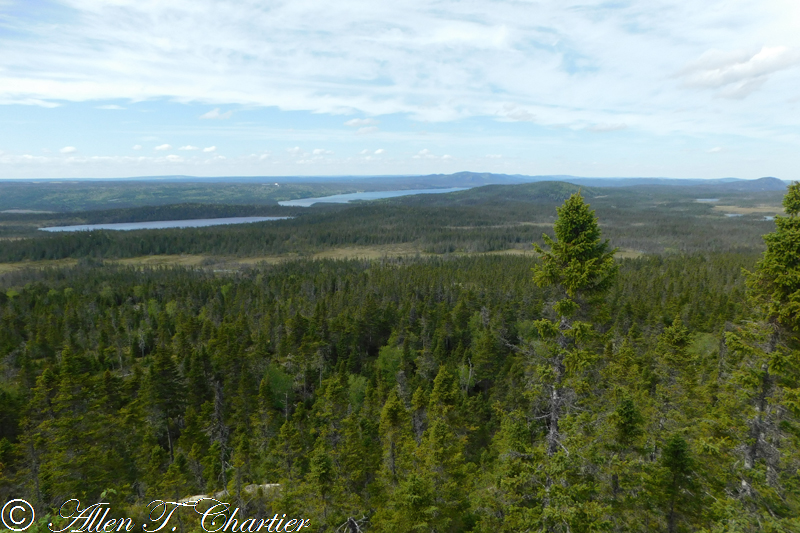
I spent about 20 minutes carefully picking my way around the rocks here, and made a short video (view it here) before I had located any ptarmigan. The view from the top was spectacular, and included Birchy Lake adjacent to the highway.

View from summit of Mount Seemore


After another 20 minutes of searching, I flushed a Rock Ptarmigan, which flew over a ridge and out of view. Not a very satisfying sighting, and not a life bird, but an objective successfully met after a lot of work. A couple of American Robins in this barren, rocky place seemed quite out of place, but apparently had come up here from the stunted spruce woodlands that were a couple hundred yards back down the road. After 5.1 miles of walking, over the course of 3 hours, I got back down to the car where I was greeted by a butterfly that turned out to be a lifer, Green Comma.

Green Comma (Polygonia faunus)


For those who are interested, my eBird checklist for Mount Seemore is here:

https://ebird.org/checklist/S112801238

From here, we continued on about an hour to Corner Brook, where we spent the next 3 nights.

Wednesday, June 22, 2022

Bonavista and Terra Nova, Newfoundland

 Our first destination this morning was the small town of Elliston, at the northeastern tip of the Bonavista Peninsula. After an hour and a half drive, we arrived in the town, and made our way east to the "Puffin Viewing Site", where Atlantic Puffins could be seen close by without going on a boat trip. There was a short (1/2 kilometer) trail out to the site and of course it was on a scenic shoreline.

Elliston Puffin Viewing Site


The puffins, of which there are perhaps 2000 to 4000 breeding pairs, were easily visible on an island only about 30 yards off the point at the end of the trail.

Atlantic Puffins at Elliston, Newfoundland


Atlantic Puffins at Elliston, Newfoundland


I took one short video of the puffins, but it has a lot of wind noise and is a bit shaky because of the wind. It can be viewed here. You might want to turn the volume down before you play it. I decided to concentrate on still shots of the puffins here instead of making more shaky videos.

Atlantic Puffins at Elliston, Newfoundland


Atlantic Puffins "hovering" in the high winds at Elliston


Atlantic Puffins at a nest burrow


There were a few other seabirds here as well, including our best views of Black Guillemot.

Black Guillemot at Elliston, Newfoundland


Black Guillemot at Elliston, Newfoundland


Black Guillemot at Elliston, Newfoundland


From here it was a short drive northwest to the Cape Bonavista lighthouse, where there was a nice interpretive center, and an even more accessible (though smaller) nesting colony of Atlantic Puffins.


Atlantic Puffins at Cape Bonavista, Newfoundland


Atlantic Puffin at Cape Bonavista, Newfoundland


From here we drove southwest, back down the other side of the Bonavista Peninsula, to Terra Nova National Park. We enjoyed the scenery throughout the park.

Terra Nova NP, Newfoundland


Terra Nova NP, Newfoundland


Terra Nova NP, Newfoundland


Terra Nova NP, Newfoundland


There are several trails in the park, but we didn't have time to explore them all. On the drive to the Ochre Hill Trail, we saw our second and third species of butterfly on the trip. At Cape St. Mary's, we had seen the near-endemic Short-tailed Swallowtail but there was nothing blooming and they never sat still for photos. Today's butterflies had some nectar sources so we were able to get good looks at Canadian Tiger Swallowtails and Spring Azure.

Spring Azure at Terra Nova NP


The flowers that were blooming most abundantly were the native species of rhododendron, called Rhodora, which is what this swallowtail is feeding on.

Canadian Tiger Swallowtail on Rhodora


The parts of the Ochre Hill Trail that we walked had a few birds, with the most cooperative being a group of Boreal Chickadees.

Boreal Chickadee at Terra Nova NP


Boreal Chickadee at Terra Nova NP


Our final destination for the day was a geological site, the Dover Fault (east of the town of Dover, which is northeast of Gambo). This site is where two continental plates join. Part of northwestern Africa (Morocco) drifted westward with North America millions of years ago, and the gap between the hills in this photo is that fault line.

The Dover Fault (gap in top center)


Of course we were keeping our eyes open for other things, and at the parking area we found another butterfly, a Milbert's Tortoiseshell. It is a common species in Michigan but after a few chilly days on the Avalon (it never got to 60 F), we were having a day in the low 70s and it was nice to see any insects actually.

Milbert's Tortoiseshell, near Dover, Newfoundland


We drove to the town of Gander for the night.