Wednesday, February 2, 2011

Birds Up Close and Personal

I am very fortunate to hold the federal and state permits necessary to band birds, as part of various research projects in Michigan, Ohio, and Indiana. During spring and fall migrations especially, I have been posting weekly updates to this blog with results and photo highlights since 2007. In the process of sorting through the photos taken to add interest to the blog, I frequently examine them at full size, which gives me the same intimate views of plumage and structure that I experience in the field when banding them, up close and personal. So, to fend off the beginnings of cabin fever as Michigan is under blizzard warnings, here are some of these photos showing things that perhaps many birders have never seen. Some of these photos are so close that you may not recognize the species. Others have an impressionistic art aspect. To allow you to quiz yourself, if you so desire, I have identified each below the photo rather than above. Click on each photo to view full size.


Even up close, the mechanism behind the red iridescent throat of an adult male Ruby-throated Hummingbird is invisible, and amazing.


The green back of the Ruby-throated Hummingbird is dazzling up close.


Pulling back a little, it is interesting to see the small feathers around the eye...eyelashes of sorts.

The eyes have it. Several species have large, complete eye rings.


The gray crown might give away that this is a Blue-gray Gnatcatcher.


Field guides say they have a white eye ring, but every Canada Warbler I've banded has shown an eye ring that is yellow on top and white below, subtly beautiful.


Extra long white feathers around the eye of this Connecticut Warbler make the eye ring quite bold.


The "teardrop" eye ring of the Ruby-crowned Kinglet is actually broken on the top and bottom by the feathers encircling that part of the eye being dark olive instead of whitish.


The large eye is a good clue that this bird inhabits shady woods, and is active at dawn and dusk. The bold buffy eye ring connected to buffy above the lores is a good mark for Swainson's Thrush.


This broken eye ring may not be familiar as it is not the main field mark for the species, American Robin. Note the rather prominent "rictal bristles" at the base of the bill.


The eye ring of the Gray-cheeked Thrush is not prominent, is whiter, and the species also lacks the spectacled look of Swainson's. Also note the flesh-pink base of the lower mandibles, and the yellow gape corners.


A narrow whitish eye ring, without any pale area on the lores, is a good mark for the Hermit Thrush, along with the bolder malar streaks and breast spots.


Eye rings are not always formed with feathers. This blue and green fleshy eye ring on this Mourning Dove is quite beautiful up close, along with the bright pink gape corners on the bill.


Broken eye rings are common; this one is on a hatch-year male Northern Parula. Note also the orange lower mandible.


The broken eye ring is a very good characteristic to distinguish the Orange-crowned Warbler. Some subtle orange coloration can be seen in the crown of this male.


This broken eye ring is overwhelmed by a bright whitish supercilium, characteristic of the Tennessee Warbler.


One of the most difficult fall warblers to identify, many Blackpoll Warblers in fall are yellower than the very similar Bay-breasted Warbler.


The Bay-breasted Warbler in fall is often greener and buffier.


Colorful even in fall, the Magnolia Warbler also sports an incomplete eye ring.


There's no mistaking this beautiful spring adult male Blackburnian Warbler, even more breathtaking up close.


Immature male Blackburnians in the fall still show a lot of the pattern of breeding males, but orange is replaced with yellow.


Immature female Blackburnians are more muted in color, rarely with any bright yellow.


Another very bright, bold bird is this adult male Hooded Warbler.


The black mixed in with the greenish crown helps age this Chestnut-sided Warbler as a second-year.


One more broken eye ring is found on a bird that confuses a lot of people of the other main field mark is subtle, missing, or out of view. This is a female Black-throated Blue Warbler and her face pattern is distinctive.


Yellow eyes are very startling, as on this Brown Thrasher. On closer inspection, they're sometimes not entirely yellow.


When young, the eye color of some birds is different from the adults. This is a juvenile Common Grackle whose eye is turning from brown to yellow as it ages.


Yellow eyes, along with streaked underparts, are characteristic of juvenile Accipiters. This is a young male Sharp-shinned Hawk.


The nictating membrane is a secondary eye covering that is rarely seen in the field, and is even more rarely photographed. This is the same immature male Sharp-shinned Hawk as in the photo above. There is clearly much complexity in this membrane, as a network of blood vessels can be seen here. This membrane likely protects the eyes as these birds dive into brush piles at full speed after prey.


In general, as Accipiters age their eyes transition from yellow to a deep burgundy color. This individual adult female Sharp-shinned Hawk is at least two years old, based on molt.


This second-year female Cooper's Hawk (note the large bill) has an orange eye, but it could retain this eye color for at least another year or two, or it could turn burgundy in the next year.

Little Brown Jobs...


The long, curved bill of the Brown Creeper is pretty distinctive, but how often have you noticed that the lower mandible is fleshy-pink?


Stiff shafts on the tail feathers of the Brown Creeper resemble those of woodpeckers.


Brown birds are rarely just brown, as the intricate pattern on the wing of this Brown Creeper shows.


Another brown bird with an interesting wing pattern. Scroll down to the next photo for the ID.


The Lincoln's Sparrow is a very beautiful bird up close.


The wing pattern of this bird is very similar to the Lincoln's Sparrow above, but with much more rufous on the wing coverts.


The Swamp Sparrow is generally more boldly marked.


The subtle black barring pattern on brown suggests wrens to most birders.


This one happens to be a Winter Wren. I'm always intrigued by the interesting eye shape of wrens. Not round like most other songbirds.


Some adult female Red-winged Blackbirds can have quite a bit of pinkish on their heads, and some rufous edgings on their shoulders, especially older birds.


Most LBJs are sparrows. Identification of this one might be misleading as the rufous crown might suggest Chipping Sparrow. But the black-and-yellow bill clearly indicates it is an American Tree Sparrow.


In winter, Chipping Sparrows lose their rufous crowns and the black bills of summer turn pinkish in winter.


Field Sparrows also have pink bills, year-round, but are very plainly marked on the head with the exeption of a whitish eye ring.


Another sparrow with a blackish and yellow bill is the Fox Sparrow. Bill color, among other marks, distinguish the Fox Sparrow from the somewhat similar Song Sparrow.


The orange bill, along with the bold black-and-white crown stripes, distinguish the adult White-crowned Sparrow.


Another brown job, with bold head markings, can be distinguished by that monstrous bill...a female Rose-breasted Grosbeak.


Crisp head streaking and especially a yellow eyebrow distinguishes the Savannah Sparrow.


Another brown bird, but with a different wing pattern.


But the black-and-white head stripes and yellow supra-loral are unmistakeable field marks of the White-throated Sparrow.

Impressionistic art...


The wing of the Blue Jay is even more beautiful close up.


The yellow-edged secondaries change to black as they meet the white-tipped greater wing coverts creating a wing bar; these adjacent to the primary coverts and the alula on the right. Wing of a Ruby-crowned Kinglet.


The Northern Flicker used to be called the Yellow-shafted Flicker, for good reason.


The black malar patch of this male Northern Flicker is more than just black feathers, it is almost like a patch of felt.


Adult female Red-bellied Woodpecker.

Sunday, December 12, 2010

Old Goldie

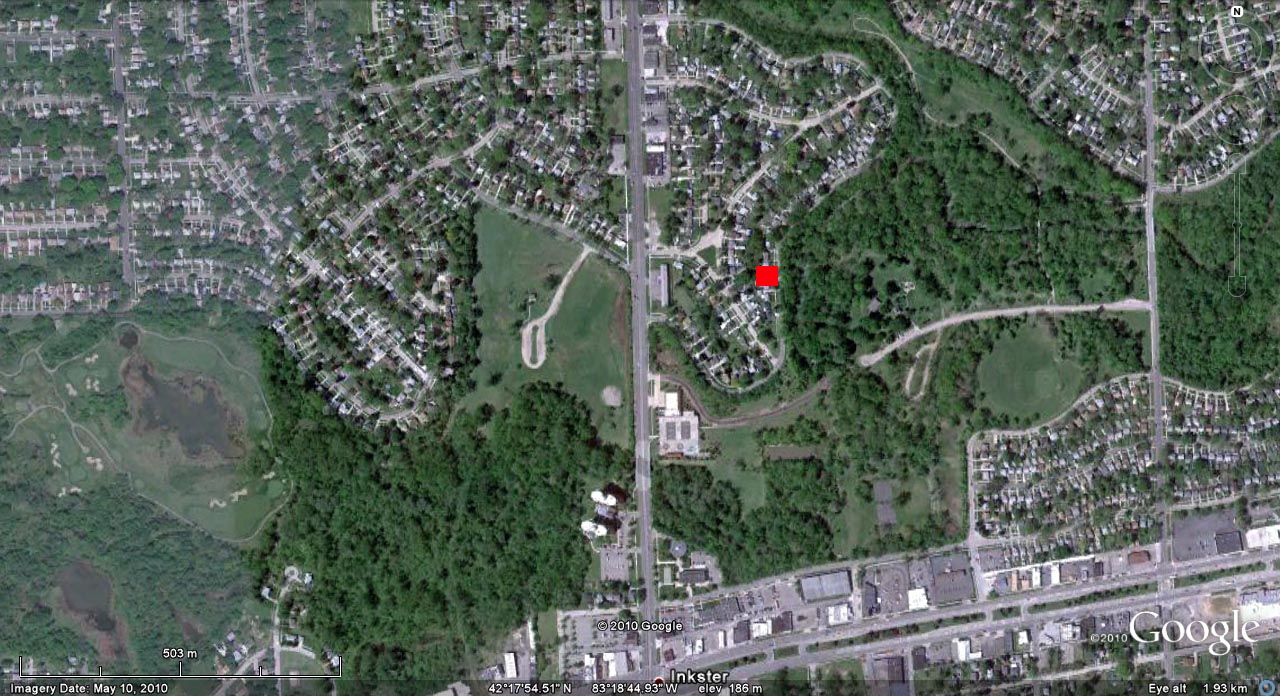
Since 2002, I have been banding birds in my back yard in Inkster, Wayne County, Michigan where, since we moved here in 1987, a total of 140 species have been recorded in, over, or from the yard. Initially only hummingbirds were banded, but in 2004 I began to band all birds in the yard to study populations and winter site fidelity. In general, in "winter" I band three days a month from October to March, and since the yard is so small, set up only two nets in the back, and two traps in the front. Through 2009, a total of 2201 birds of 30 species has been banded, not too bad for a very urban site, 5 miles northeast of Detroit Metropolitan Airport (the red square on the screen capture from Google Earth below).


A number of interesting species have been banded over the years, including 3 Cooper's Hawks, Sharp-shinned Hawk (1 in 2010), a total of 114 Ruby-throated Hummingbirds (2002-2009), a Red-breasted Nuthatch, 3 Brown Creepers, 5 Carolina Wrens, Ruby-crowned Kinglet, Hermit Thrush, Black-throated Blue Warbler, Field Sparrow, Common Redpoll (2008), and 19 Pine Siskins (1 in 2008, 18 in 2009). But more than half of all birds banded (1200+) have been American Goldfinches. It is interesting to see the population ups and downs over the years, but it is the recaptures that are even more interesting. Over the years, I've caught two different American Goldfinches banded in Dearborn, 5-6 miles away, by Julie Craves. One of the goldfinches I banded in the yard was found in spring near Hamilton, Ontario. Each winter, several goldfinches banded in previous winters return, and birds that are 3-4 years old are not too uncommon.

Last week, however, I caught an adult male goldfinch that I had originally banded as a second-year male on March 9, 2004. This means he was hatched in summer 2003, so was 7 years old this summer. This is by no means the oldest American Goldfinch on record. The Bird Banding Lab maintains a web page of longevity records, where they show the record for American Goldfinch as 10 years, 5 months. The standard way of determining a recaptured bird's age is to presume it was fledged in June. This works well for most songbirds, but late-nesting species like Cedar Waxwings and American Goldfinches may not fledge until July or August (or even early September). But even though he isn't the oldest, it appears he is among the oldest (maybe 7th oldest), and so I've nicknamed him Old Goldie. Oddly, unlike many other goldfinches that are recaptured in the yard, this bird has not been captured even once since he was originally banded in 2004. Maybe he'll change his pattern and return in a couple years.


This isn't Old Goldie, but another winter adult male American Goldfinch.


Friday, December 3, 2010

Three December Hummingbirds in Michigan

Michigan in December is not normally thought of as a welcoming place for hummingbirds. But on December 1, 2010, there was not only one, but THREE hummingbirds of THREE species in the state. Most readers of this blog will know that only the Ruby-throated Hummingbird breeds here, and is the only expected species at any time.

At Grand Marais, in the Upper Peninsula, two homeowners had taken down their feeder on the 1st or 2nd of October because they had not seen a Ruby-throat in about ten days. The next day, it became apparent to them that there were still two hummingbirds present and they put the feeder back up. Over the course of the next two weeks, they became suspicious that the adult male might not be a Ruby-throat but something else. On October 24, they took his photo and by October 27 several local birders had confirmed he was actually an adult male Anna's Hummingbird, a first ever in Michigan! Others have taken better photos, but below is one that I took of him on an overcast day, November 1, 2010. His pose in this photo is characteristic of an Anna's Hummingbird singing, which he was noted to do rather frequently from this favorite perch in an apple tree.


The other bird was also photographed around that time, and was assumed to be a female Ruby-throated. But closer examination of the photos by me and others suggested that this hummingbird was also an Anna's Hummingbird, likely a female! Determining the age of female Anna's Hummingbirds is difficult without having the bird in-hand, or good photos of the spread tail. My own photos, one below, suggests to me that she is an adult as it appears there is white on the second rectrix, which an immature might not show.


The adult male Anna's Hummingbird was last seen on November 11. As this species begins nesting as early as December in California and February in southwestern British Columbia, his departure at this time makes sense. The female was still on-site on December 1, despite the temperatures dipping into the 20s and 30s, and a snow accumulation which is expected this time of year in the Upper Peninsula. It is worth noting that an Anna's Hummingbird spent the entire winter of 2009-2010 in the Alaska Panhandle.

On November 10, I traveled to the northern Lower Peninsula, near Irons in Lake County, where homeowners were reporting a hummingbird that, based on photos sent to me by local birders, was either a Rufous or Allen's Hummingbird. Although there are 26 accepted Michigan records of Rufous Hummingbird between 1974-2009, only two have been from the Upper Peninsula and only three from the northern Lower Peninsula (two in 1988 and one in 1989). There are an additional 7 accepted records of Rufous/Allen's Hummingbird (species undetermined) between 1988-2007, of which one was from the northern LP and the rest from the southern LP. Upon capturing and banding this hummingbird, it was determined that she was a hatch-year (immature) female Rufous Hummingbird.


The diagnostic character for Rufous Hummingbird is often the presence of "notches" on the second tail feather (centrals are the first). But as is often the case, in my experience, with immature females this notching is very subtle or even non-existent (see spread tail photo below). In this case, it comes down to the measured widths of the first (central) tail feather and the fifth (outer) tail feather. In these measurements, she was within the range of Rufous and outside the range of Allen's, which measures narrower, but in some cases by only a fraction of a millimeter.


This hatch-year female Rufous Hummingbird was still present on December 1, 2010. The homeowners have nicknamed her "Tinkerbell".

On October 18, 2010, a homeowner near New Boston, Wayne County in Michigan's southern Lower Peninsula, noticed a hummingbird at a feeder he hadn't yet taken down although he hadn't seen a hummingbird for more than a week. After photos were obtained by local birders in early November, it was determined that she was a female and/or immature Ruby-throated Hummingbird. This species lingers into October in varying numbers every year in Michigan, but there are only about 10 confirmed records for November. Daily reports kept coming in, and I personally went to see this bird on November 12, when I guessed that she was an adult female based on the state of her molt. She seemed quite active and came in to the feeders several times, but I never got photos of her perched on the feeder.


On November 26, I went to the home to band her, and to assess her condition. I confirmed that she was an adult female, and that she had a good amount of body fat. This was good news suggesting that she should migrate eventually. Her weight was 3.91 grams, which is well above many that I band in late September, and significantly above the typical "non-fat" weight of about 3.25 grams. Since the temperature when I banded her in the afternoon had finally risen to 32 (from 25 in the morning), I was reluctant to take photos of her in-hand, so released her quickly. She returned to the feeder within 20 minutes. A photo of her perched in her favorite Witchhazel tree shows the worn tail tips, which is a clue to her being an adult.


Her presence on November 26 tied the record late date for the species in Michigan, as there had been one on November 26, 2009 in southwestern Michigan (Allegan County), and one from Halloween through November 26, 2007 in Marquette, amazingly in the Upper Peninsula. But she continued on and was still present on December 1.

It has been an amazing fall season for hummingbirds in Michigan.

Friday, November 12, 2010

Metro Beach Fall 2010 Banding Summary

Banding was conducted on a total of 24 days between 7 August and 3 November 2010, which is consistent with protocols although a couple days were "non-standard" with fewer nets run. A record number of 2201 new birds was banded, of 71 species which is the second highest ever and tied with number of species banded in 2009. In addition, 268 birds were recaptured and 53 released unbanded, resulting in a total number of captures of 2522. The number of net hours (1776.69) was the second highest ever, and almost the same number as 2009. The capture rate of 141.9 birds per 100 net hours was the highest ever by a considerable margin. Below is a simple species list with number banded this fall. More details will be published as a PDF file on the Metro Beach Banding website.

Fall 2010 Banding Results

Sharp-shinned Hawk - 2
Mourning Dove - 1
Ruby-throated Hummingbird - 86
Yellow-bellied Sapsucker - 1
Downy Woodpecker - 4
Northern Flicker - 2
Eastern Wood-Pewee - 3
Yellow-bellied Flycatcher - 2
Alder Flycatcher - 1
Willow Flycatcher - 4
"Traill's" Flycatcher - 6
Least Flycatcher - 3
Blue-headed Vireo - 2
Warbling Vireo - 1
Philadelphia Vireo - 1
Red-eyed Vireo - 6
Blue Jay - 22
Northern Rough-winged Swallow - 1
Black-capped Chickadee - 25
Red-breasted Nuthatch - 1
White-breasted Nuthatch - 4
Brown Creeper - 22
House Wren - 29
Winter Wren - 12
Marsh Wren - 2
Golden-crowned Kinglet - 79
Ruby-crowned Kinglet - 33
Blue-gray Gnatcatcher - 1
Gray-cheeked Thrush - 7
Swainson's Thrush - 25
Hermit Thrush - 71
American Robin - 8
Gray Catbird - 8
Tennessee Warbler - 19
Orange-crowned Warbler - 5
Nashville Warbler - 40
Northern Parula - 3
Yellow Warbler - 11
Chestnut-sided Warbler - 9
Magnolia Warbler - 62
Cape May Warbler - 2
Black-throated Blue Warbler - 51
Yellow-rumped Warbler - 33
Blackburnian Warbler - 4
Palm Warbler - 12
Bay-breasted Warbler - 3
Blackpoll Warbler - 47
Black-and-white Warbler - 7
American Redstart - 42
Ovenbird - 14
Northern Waterthrush - 14
Connecticut Warbler - 1
Mourning Warbler - 3
Common Yellowthroat - 60
Wilson's Warbler - 12
Canada Warbler - 4
Northern Cardinal - 7
Rose-breasted Grosbeak - 2
Indigo Bunting - 2
Eastern Towhee - 1
American Tree Sparrow - 12
Field Sparrow - 1
Fox Sparrow - 19
Song Sparrow - 170
Lincoln's Sparrow - 36
Swamp Sparrow - 77
White-throated Sparrow - 379
White-crowned Sparrow - 43
Dark-eyed Junco - 6
Red-winged Blackbird - 1
American Goldfinch - 512